A dining room already carries a certain formality on its own, but how inviting that room actually feels depends on far more than simply owning a table and chairs. Filling the space is only the starting point — what separates a dining room that feels warm and considered from one that feels stiff or underused is how lighting, color, furniture scale, and table styling are all coordinated to work together rather than existing as a series of disconnected purchases.
Getting that coordination right depends on a few factors: how well the lighting suits both everyday meals and larger gatherings, how furniture is scaled and spaced relative to the room itself, and how consistently the table and walls are styled so the room feels finished rather than sparsely furnished. A dining room with a beautiful table but harsh overhead lighting reads very differently than the same room finished with layered lighting and a considered color palette, even though both technically qualify as “decorated.” Here are fifteen approaches worth knowing, along with what makes each one distinct.
It’s also worth thinking of lighting, furniture, and styling as three separate design decisions that need to work in conversation with each other, rather than one automatically following from the other. The same dining table can look completely different depending on whether it’s paired with a statement chandelier and a considered color scheme, or a single bare overhead bulb and mismatched chairs, and choosing all three together — rather than picking furniture first and addressing lighting and styling as an afterthought — tends to produce a far more inviting, cohesive result.
1. A Statement Chandelier Sized to the Table: Lighting as the Focal Point

Hanging a chandelier or pendant fixture sized appropriately to the table below it instantly elevates a dining room, since lighting positioned directly over the table draws the eye and reinforces the table as the room’s central feature rather than leaving it competing with other light sources.
Getting the scale right matters more here than in most other rooms, since a fixture that’s too small can look lost above a large table, while one that’s too large can feel overwhelming in a smaller space. Hanging the fixture roughly thirty to thirty-six inches above the tabletop, adjusted slightly for ceiling height, tends to produce the most balanced proportion between the light and the table beneath it.
2. Layered Lighting With a Dimmer: Flexibility From Morning to Evening

Relying on a single overhead fixture alone often leaves a dining room either too bright for an intimate dinner or too dim for daytime use, so layering in wall sconces, a sideboard lamp, or accent lighting alongside the main fixture — with a dimmer on the primary light — allows the room’s mood to shift throughout the day.
This approach depends on planning the additional light sources early, since running wiring for wall sconces after a room is already finished is considerably more disruptive than including it during an initial renovation. Choosing warm-toned bulbs across all the layered sources, rather than mixing warm and cool tones, keeps the room feeling cohesive regardless of which lights are on at a given moment.
3. A Bold Accent Wall Behind the Table: Color as a Backdrop

Painting or wallpapering a single wall — typically the one behind the head of the table or visible from the room’s main entrance — in a bold color or pattern gives the dining room a strong visual anchor without requiring the same commitment across all four walls.
The rest of the room’s walls and larger furniture should stay closer to a neutral tone in comparison, since a bold accent wall paired with an equally bold color elsewhere in the room tends to compete rather than complement. Choosing furniture and decor in materials that pick up one or two tones from the accent wall, rather than matching it exactly, helps the room feel intentional rather than overly literal.
4. A Well-Proportioned Area Rug Under the Table: Grounding the Space

Placing an area rug beneath the dining table, sized so that chairs remain on the rug even when pulled out, grounds the furniture and adds warmth and texture to what’s often a hard-flooring space, particularly in open-concept homes where the dining area isn’t otherwise clearly defined.
This approach depends on choosing a rug large enough for the full furniture arrangement, since an undersized rug — one where chair legs regularly fall off the edge — tends to look more awkward than no rug at all. A flatter pile or an outdoor-rated indoor rug in the dining area specifically helps chairs slide in and out more easily than a thick, plush rug would allow.
5. Open Shelving or a Glass-Front Cabinet for Displaying Dishware: Function That Doubles as Decor

Open shelving or a glass-front hutch that displays curated dishware — a matching set of plates, a few decorative serving pieces, glassware arranged by size — turns everyday storage into a visible part of the room’s decor rather than hiding it away entirely.
Keeping what’s displayed limited and consistent in color or material, rather than filling every shelf edge to edge, helps the display read as curated rather than accumulated. Periodically rotating in seasonal pieces, like a different centerpiece bowl or accent glassware, keeps the display feeling current without requiring a full restyle.
6. A Mixed Seating Arrangement: Visual Interest Around the Table

Pairing upholstered dining chairs at the head and foot of the table with simpler wood or metal chairs along the sides — or mixing a bench on one side with individual chairs on the other — introduces visual variety around the table without sacrificing the cohesion a fully matched set would provide.
This approach works best when the mixed pieces still share a common material, color, or design language, since chairs that are too visually different from each other can make the arrangement look unplanned rather than intentionally varied. Keeping seat heights reasonably consistent across the mixed pieces ensures the arrangement stays comfortable and proportional at the table.
7. A Gallery Wall as the Room’s Visual Anchor: Personality Through Curated Art

Arranging a collection of framed art, photography, or mirrors on one wall — often the wall a seated guest faces most directly — gives the dining room a personal, layered focal point that a single piece of art typically can’t achieve on its own.
Planning the arrangement on the floor before hanging, and keeping consistent spacing of a few inches between frames, helps the gallery wall read as a cohesive collection rather than a scattered assortment. Choosing frames in two or three consistent finishes, rather than a completely random mix, keeps the wall feeling curated even when the art itself varies in style.
8. A Statement Centerpiece Kept Low Enough for Conversation: Styling the Table Itself
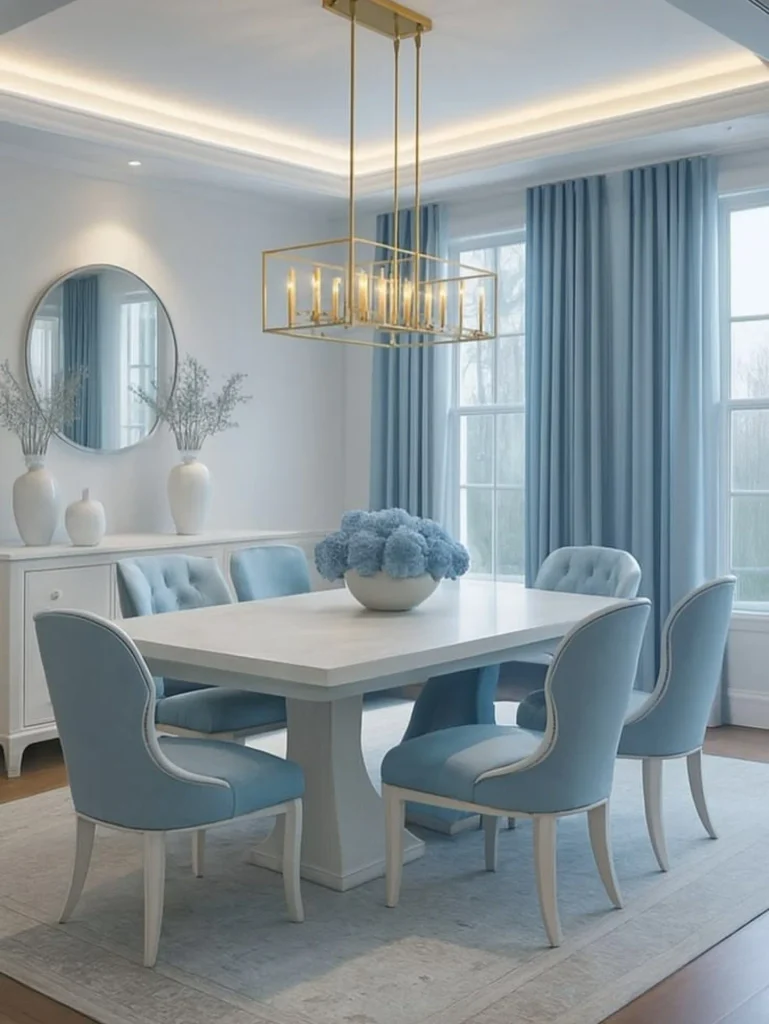
A single well-chosen centerpiece — a low floral arrangement, a runner with a cluster of candles, a bowl of seasonal fruit — finishes the table itself, which often gets overlooked once the surrounding furniture and walls are decorated, even though it’s the part of the room guests interact with most directly.
Keeping the centerpiece low enough that seated guests can see each other across the table matters more than height or size, since a tall arrangement can block sightlines and make conversation feel unnecessarily awkward. Swapping the centerpiece seasonally, or for specific occasions, keeps the table feeling considered without requiring changes to the rest of the room.
9. A Coordinated Table Linen Rotation: Easy, Low-Commitment Change

Keeping a small rotation of tablecloths, runners, and cloth napkins in two or three coordinating colors allows the dining room’s overall look to shift for different seasons or occasions without touching any of the room’s larger, more permanent elements.
This approach works particularly well as a lower-cost way to keep a dining room feeling current, since linens are considerably less expensive to update than furniture or lighting. Choosing linens in materials that are easy to launder regularly, rather than delicate fabrics requiring special care, keeps this rotation realistic to maintain given how often a dining table actually gets used.
10. A Sideboard or Buffet for Serving and Storage: Function Along the Perimeter

A sideboard or buffet placed along a wall not occupied by the table provides both serving space during larger meals and storage for linens, serveware, and extra dishware, which keeps those items out of view while still being close at hand when needed.
This piece works best when its material and finish echo something already present in the room — the table’s wood tone, or a metal finish shared with the light fixture — rather than introducing an entirely new material into the space. Leaving the top surface mostly clear, aside from a lamp or a small styled vignette, keeps the sideboard functional as serving space rather than becoming another surface that accumulates clutter.
11. Wallpaper or a Textured Wall Treatment on All Four Walls: Full Immersion

For dining rooms used primarily for special occasions rather than everyday meals, wallpapering or texturing all four walls — rather than a single accent wall — creates a more immersive, formal atmosphere that can feel dramatic in a way a single accent wall doesn’t achieve.
This approach depends on keeping furniture and decor simpler in comparison, since a fully patterned or textured room paired with equally busy furniture can quickly feel overwhelming rather than elegant. Testing a wallpaper sample in the room at different times of day helps confirm the pattern and color will read as intended under the room’s actual lighting conditions before committing to the full installation.
12. Mirrors Positioned to Expand the Room Visually: Light and Space Without Renovation

Hanging a large mirror, or a cluster of smaller ones, across from a window or light source amplifies natural light and makes a dining room feel larger than its actual footprint, which is particularly useful in dining rooms that are enclosed or lack much natural light of their own.
Positioning the mirror to reflect something worth seeing — a window, a piece of art, the chandelier — rather than a blank wall, gets more visual benefit out of the placement. Choosing a frame finish that matches or complements other metal finishes already in the room, like the light fixture or chair legs, helps the mirror feel integrated rather than added on separately.
13. A Built-In or Freestanding Bar Nook: An Adjacent Function

Dedicating a small corner of the dining room, or an adjacent nook, to a bar cart or built-in bar area gives the room a secondary function for pre- and post-dinner drinks without requiring guests to relocate to another part of the house.
This approach works best when the bar area stays visually consistent with the rest of the room’s material palette, rather than introducing a completely different style or color scheme. Keeping the bar cart or nook lightly stocked and tidily arranged, rather than crowded with every bottle and glass owned, keeps it looking like an intentional feature rather than overflow storage.
14. Seasonal Greenery or a Single Statement Plant: A Living Element
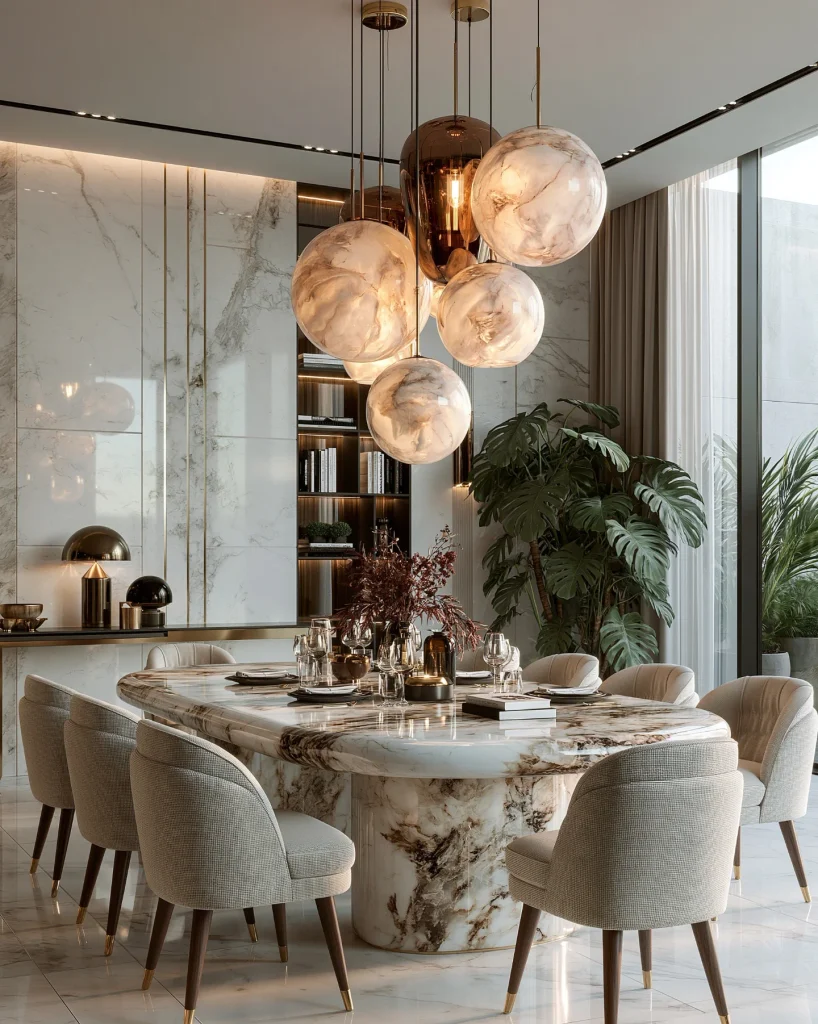
Adding a single well-placed plant — a tall floor plant in a corner, or a smaller arrangement on the sideboard — introduces a natural element to the dining room without requiring the ongoing care a full garden of plants would demand.
Choosing a plant suited to the room’s actual light conditions, since dining rooms are often used more in the evening and may get less consistent daylight than other rooms, helps ensure the plant stays healthy rather than becoming a wilting distraction. Repotting into a planter that matches the room’s broader material and color palette helps the plant integrate into the decor rather than standing apart from it.
15. Seasonal Reassessment of the Full Room: Maintaining a Considered Look Over Time

Dining rooms tend to accumulate small changes gradually — a new candle here, a gift displayed there — so scheduling a seasonal reassessment of the room’s linens, centerpiece, and displayed decor helps keep the space feeling intentional rather than slowly cluttered by additions that were never planned together.
This reassessment works best when treated as routine upkeep rather than a major redecorating event, similar to a seasonal linen rotation rather than an occasional full overhaul. Stepping back and viewing the room from the doorway, rather than only from a seated position at the table, helps catch small inconsistencies that are easy to miss while sitting inside the space day to day.
Choosing and Maintaining a Cohesive Dining Room
With fifteen distinct approaches to consider, a few practical principles help identify which combination will actually suit a specific dining room, household, and how often the space actually gets used.
Room usage should guide which approaches matter most. A dining room used mainly for everyday family meals benefits disproportionately from layered, dimmable lighting and low-maintenance linens, while a room reserved for special occasions gets more value from a fully wallpapered treatment or a dedicated bar nook. Trying to apply every approach equally regardless of how the room is actually used often produces a less practical result than identifying which two or three ideas suit the household’s real habits.
Lighting and color choices affect how the room feels at different times of day. A bold accent wall or full wallpaper treatment reads very differently under daylight than under evening chandelier light, so testing color and lighting choices at the times the room actually gets used helps avoid surprises after the work is finished. Establishing the lighting plan early, before finalizing wall color or furniture, tends to prevent the mismatched feel that comes from decorating pieces independently rather than as a coordinated whole.
Maintenance capacity deserves real consideration before committing to a particular styling approach, since some elements — a rotating linen collection, a curated open-shelving display, seasonal centerpiece changes — require ongoing attention to stay effective rather than functioning as a one-time setup. Choosing an approach that realistically matches the time available for upkeep keeps the dining room looking finished between larger updates rather than gradually reverting to a plain, undecorated table.
Finally, decorating a dining room is generally more successful when treated as a layered process rather than a single purchase. Starting with lighting and furniture scale, then building in color, texture, and table styling, and reassessing the room periodically allows the underlying principles — proportion, warmth, and considered detail — to hold up over years of use rather than fading once the room’s newness wears off.
Being specific about how the room is actually used, what lighting the space realistically needs across the day, and which one or two colors and materials will anchor the room helps translate a general goal like “dining room decoration” into the precise combination of choices described above. Because small differences in lighting, scale, and table styling produce such different overall results, that extra bit of specificity at the planning stage is often what separates a dining room that feels genuinely inviting from one that simply has a table and chairs in it.